Friday, March 6, 2020

Christmas Eve at the Mercado


We picked up a few things at the organic market—home-made pasta, smoked cheese, a very nice baguette, some cookies, and a loaf of multi-grain bread. Then we pressed on to the mercado for fruits and vegetables for the next few days. We weren’t really sure what to expect about closures for the holiday, so it seemed prudent to stock up.

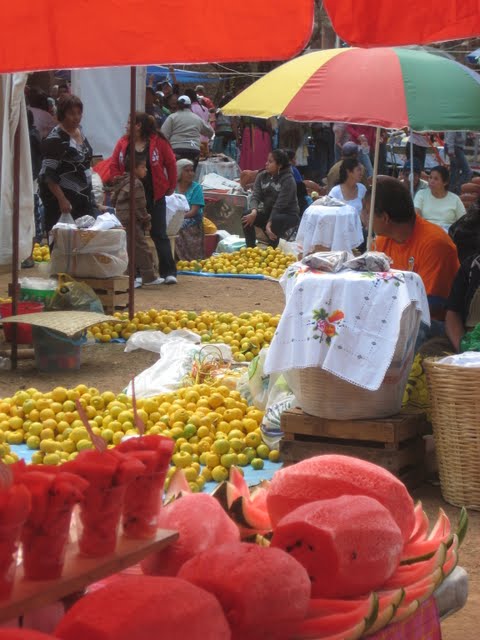
Apparently everyone else had the same idea, because the mercado was more crowded than ever, and that’s saying something. It was a real scrum, with people packed into the narrow aisles, almost unable to move forward. We struggled to find carrots, green beans, potatoes, juice oranges, papaya, cherimoya and chico mamey, which we now learn should be called chicozapote. I don’t think the vendors will appreciate the distinction, so we’ll continue to call them chico mamey. Regardless of the name, they are completely delicious.

Here’s a photo, with a mandarin orange for size comparison. There are usually a few small dark seeds, unlike cherimoya which has many seeds.

The flavor has been described as similar to a pear (though I’ve never tasted a pear this sweet), with a slightly granular texture. We first tasted it in Chetumal, on the border with Belize, and the vendor told me it was “like honey,” and she was right. These come from Nueva Italia, in the Tierra Caliente region of Michoacán—lower in altitude, much warmer, and not very safe for travelers. This is where marijuana (mota) is also grown.

After loading up with produce we went to Merza, a small supermarket near the plaza, for a few staples and a bottle of wine to bring to a Christmas party. It was also jammed, but fortunately the management had installed a couple of temporary checkout counters to accommodate last minute shoppers like us.

Being overburdened with weight and pretty tired of the crowds, we hopped on our combi and rode home in relative comfort.

This is the statue of Gertrudis Bocanegra, the namesake of the Plaza Chica (formally La Plaza Getrudis Bocanegra), the heroine of the Independence. She looks like a woman not to be messed with. Nearby were a couple of abandoned cowboy boots. There’s a story there, if only we knew it. And then there was the single white high heel on the floor in the mercado.

Christmas Eve dinner at our house was poblano chiles stuffed with a mixture of bacalao (salt cod), tomatoes, capers, onions, and a bit of chiles manzanas (apple chiles, very picante but also very flavorful), warmed in the oven and served over white rice, with fresh green beans. Bacalao is traditional for Christmas Eve in Mexico as well as in many other cultures, plus we love the stuff.

Ordinarily we eat Mexican style, with our main meal (comida) in mid-afternoon, but on Christmas Eve it was dinner, at night. The poblano was extremely tasty, though the kitchen cleanup was extensive. A price worth paying.

A Taste of the Rainy Season

This evening, around 5:30, we had rain. Not just rain--also dramatic lightning and thunder rolling around the mountains. It was very impressive, I thought, until it started to come down in buckets.
Remember Us?

After writing what I realized was like the dreaded Christmas Letter I decided to delete it. Instead I want to reflect on what the past few years since we've posted to this blog have meant to Mark and me.

We have a beautiful home, many intelligent and charming friends, a meaningful life in a country that, while it's pretty accurately described as dysfunctional, is gracious and welcoming. We are diligently studying Spanish and to our delight and amazement we're actually able to have conversations on the telephone or in person without making too many mistakes. This opens us to meaningful connections with our neighbors (Hilda makes the best tamales every Saturday), chats with the vendors in the mercado, and jokes with the taxi driver who takes me home from the mercado. The weather, the number of tourists in town, the condition of our street (terrible)--it allows us to have a sense of belonging. Not deep but enough.

I for one feel very privileged to have had this opportunity to live in another culture and language. The rich indigenous presence here, seen on the street every day as the women wear their traditional dress, is around us always. Just seeing how women use their rebozos (shawls) to carry children, keep warm, haul home heavy loads, or just decorate themselves, is instructive. The Pure'pecha culture is very much alive and well and by and large the people are very friendly.

We both feel it was one of the best things we've ever done. It's a shame that some people come to México only because the weather is good and the living is cheap. Well, here in Pátzcuaro the weather isn't all that good sometimes--we've had over an inch of rain today and it's not over--and it's not as cheap as it used to be. People who move to Pátzcuaro are a different breed. I remember seeing a PBS documentary in the 1970s about a community of people who lived in Scotland where it's hard to grow anything. One of the members said something that has stayed with me. He said, and I'm paraphrasing, it takes a little crack for the light to shine through. So all of us have that little crack, and that's why we're here.

Future postings will have more photos. But in the meantime, here's one from the fireworks from Dia de Independencia on the Plaza Grande--the figure in the middle is Vasco de Quiroga, Tata Vasco, who is beloved here. Google him--it's worth knowing about what he did here in the 1530s and why people still love him.

Semana Santa (as promised)

"The neighbors of Clavijero Strreet are invited to decorate the front of their houses with purple and white for the Way of the Cross of the Young People's Procession 2011, Friday, April 22 at 11am. Christ lives!"
We'd seen the hand-lettered signs posted around the neighborhood, but we were still unprepared on Good Friday when a procession came in front of the house. The young people from El Sagrario, a picturesque church down the hill in Centro, were re-enacting the Stations of the Cross, or Via Crucis. So Mark got his hat and I grabbed my umbrella, and we followed the rather large crowd as they went through the neighborhood.

Emergency assistance at the back of the procession
We stopped at the back gate of the Ex-Colegio Jesuita, where we waited for about 20 minutes before the gates opened. There, on top of a small mound (that is said to be the remains of a pre-Conquest pyramid) the major personalities of the Crucifixion were already in place. Along the slope were several women in robes, and a man portraying Joseph of Aremithea, with Mary Magdelene much farther down the slope. Several Roman soldiers were on top of the mound with the cross and the young man portraying Jesus was tied to the cross and raised up. Mary and Martha were kneeling below the cross.

A man had been reading from a script throughout the procession, and at this point he asked the crowd to kneel, which they did. The young man on the cross proclaimed  "Está terminado!" (It is finished.), and the reader asked the crowd to bow down; the ones who were able to (some were too old to do that) put their heads on the ground.

At the end, the crowd left in silence, and the young man was helped out by friends, obviously exhausted both physically and mentally by his experience.

Jesus' coffin from the Basilica
That night we attended the Procession of the Crosses, from the churches in town, accompanied by parishioners carrying candles. The procession began in front of the Basilica and went down to Plaza Chica, moved on to Plaza Grande and finally returned to the Basilica. Some of the crosses, from the major churches, were very large and obviously heavy because there were extra bearers who were ready to take over from someone who needed to rest. Following the crosses were images of the Virgin, carried by women. The crowd watched respectfully as the procession passed.

The Hermanos Encapuchados and the Procession of Silence
On Saturday night we watched the Procession of Silence, which to me was much more profound. The Hermanos Encapuchados (the Hooded Brothers) walk barefoot through the town accompanied only by a mournful bugle and muffled drums, and the people watching maintain silence. (Except for one old woman, who was forcefully scolded by another woman, telling her to have some respect and be quiet.) It was quite eerie to see these men, robed and hooded in black or purple, walking slowly through town.

A short video of the Procession of Silence:

By Sunday morning the purple had been removed from the altars of the churches and the Easter season was coming to a close. The last event, for Sunday night, was the annual Burning of Judas, which we chose not to attend (though we did see the spectacular fireworks from our house.) Judas is paraded through the streets before being set on fire. He's stuffed with noisy fireworks which explode as he burns. Maybe next year.

More photos from the processions:


The procession from the Basilica went on into the night
One group of the Hermanos Encapuchados
Solemn women accompanying a statue of the Virgin
Some were not appropriately dressed--is that a corset?

But there are always angels

I Coulda Been a Star!

One afternoon a friend called, asking if we wanted to be in a video to publicize Michoacán that was being shot by a film company from México City. Pátzcuaro and Morelia are in the state of Michoacán, and because tourism has been so heavily affected by news coverage of the cartel wars the state wanted to promote a more positive message.

Our friend said she was crossing Plaza Grande on the way to the mercado a block away when she was pursued by a young woman with a clipboard. Could she appear in a tourism video, and could she ask her other gringo friends if they would also appear? She thought, "Why not? Could be fun." And that's when she called us.


Mark decided that he wanted to go to the movies instead, so after several changes of schedule I met our friend at 6pm. We were transported to the yácatas (the spectacular archeological site) at Tzintzuntzan, about a 15 minute ride from town. We had already been told what to wear--capris, light-colored tops, and sandals. I did the best I could with my limited wardrobe, but when we arrived we were immediately dressed in other clothes.

The production company was filming the Purépecha Fire Dance,and apparently we were to be the enthusiastic gringo audience. Shortly after we arrived, however, we were joined by a young Spanish artist, Jaime, growing the audience to three.

We did manage to catch a rehearsal of the Fire Dance at the yácatas, with young men in ethnic dress chasing a burning ball of rubber in the dry grass around the site. This is the dry season and everything is flammable. Nearby were large patches of burned grass, indicating that rehearsal time had been extensive and sometimes exciting.

Here's a short video--notice how they snuff out the fire ball.

Every time we wandered toward the filming area we were herded back to a small stone building. We shared it with the costume mistress and her collection of costume items, ironing board and steamer, and 6 young local Purépecha women dressed in what I assume were supposed to be authentic costumes. In fact they looked more Hawaiian to me.

We waited. And waited. At one point a representative of the movie company came in to chat, and we peppered him with questions about when we would be filmed. He called the director several times and each time he was told, "another half hour." When the young women took off their costumes and went home we knew things weren't going well. By then we were known as "las turistas," the tourists, and our friend noted that we were now a commodity.

At 10pm we agreed that if nothing happened in the next 15 minutes were were leaving. Jaime said he would stick around for a little while longer, though I don't know how things worked out for him. As we left the director was heard on the radio asking the crew to go into town and find more "turistas." Where he expected to find tourists at 10:30pm in a small town was not our problem.

Fortunately I'd called Mark and he'd come out after the movie to see what was happening--which was not much. So he rescued us and took us home. On the way we puzzled over why it was so hard to film our short scene while we were available. Seemed a lack of coordination and planning, but we concluded it was not our problem.

I love going to the archaeological site because the structures are unusually constructed and spectacularly located. The yácatas stand on an immense platform overlooking  the red tile roofs of Tzintzuntzan and the lake beyond, and it's a blissfully peaceful place visited by only a few people at a time. I love the place, and the opportunity to visit, even though nothing came of it, was a pleasure.

But still.

The Palm Sunday Concurso in Uruapan

Every year on Palm Sunday there is a large artisan competition and market in Uruapan, the second-largest city in Michoacán. Uruapan is significantly lower, and therefore warmer, than either Morelia or Pátzcuaro, and is the center of avocado production in the region. Michoacán produces 30% of the world's avocado crop, and that's a lot of avocados. Something like 40 millions tons a year.

It's about a 45-50 minute drive from Pátzcuaro to Uruapan on a good toll road (44 pesos, about $4), and despite being densely populated it's not too hard to negotiate the streets to get where you want to go. We drove immediately to a parking garage near the main plaza, which in Uruapan is a long rectangle, and headed first to a nearby small plaza where each Purépecha village in the region had set up booths to serve their traditional foods.

Having had only a bolillo with some butter and jam before we left, we were both ready for something more substantial. After cruising the various booths, we opted for a couple of blue-corn gorditas stuffed with cheese and squash blossoms cooked on a comal over a wood fire, with a spoonful of roasted tomato and chile salsa added as desired. The crowds of people happily eating, along with the smoke of the fires, contributed to our overall appreciation of simple, traditional food. Other booths served chicken with mole, uchepos (sweet corn tamales), corundas (tamales wrapped in corn leaves), and various soups.

Then it was time to walk a few blocks to the Fábrica de San Pedro, an 19th-century textile mill operated by an elderly American woman, where we could see the exhibits of the concurso. The Fábrica is pretty run down, with broken windows and derelict machinery, but like most old structures that once were magnificent it was a lovely space to show the beautiful crafts. The concurso displays the best of the best, but only a few receive top honors.

At one point the officials herded us toward the entrance, where the Michoacán governor made a short speech and officially opened the exhibit. He was surrounded by his entourage, but as Mark said there was absolutely no security in place--no metal detectors, no guys in dark glasses and suits with electronics in their ears, no searching of purses and bags.

We bought only two modest purchases for the new kitchen, which we'll leave with a friend rather than taking them home, but we made notes about what we want to look for when we return in the fall.

Then we walked back to the plaza, covered with canopies and filled with vendors. Most of the work is mass-produced

Love is in the Air

As I waited for Mark to meet me in the Plaza Grande after his Spanish class earlier in the week, I was amused to watch a pair of pigeons in the midst of their pre-mating ritual. A female, slim and sleek, walked in a zig-zag pattern from one side of the sidewalk to the other, closely followed by an amorous male. He was literally inches behind her, and they were walking very rapidly, their little feet a blur. She didn't seem to be paying any attention to him, though she knew he was there.

While she looked very trim, he, on the other hand, had fluffed up his neck feathers and was crouched low, almost dragging his spread tail feathers on the ground.

When Mark arrived I was laughing and feeling a little sorry for the male, who kept getting interrupted by passers-by who broke up his efforts to win the heart of the lovely female.

Food

You knew I'd get to this subject sooner or later, didn't you?

Here's how our eating life is structured in Mexico (and for that matter, at home). For breakfast we have a large bowl of fruit (mango, papaya, pineapple, strawberries, blackberries--whatever we find in the mercado) with yogurt and granola. I walk across the street to the little store and buy 2 bolillos (small crusty breads), which is all that remains of the legacy of the French in México. Remember poor Maximillian, who came to such a bad end in Querétaro when he was shot by firing squad after trying to escape? By the way, the verb for "to shoot by firing squad," so bulky in English, is "fusilar."

With this we have fresh squeezed orange juice, from oranges that are 3 or 4 kilos for 10 pesos. Also we usually have some cheese, though the last time we went to Morelia we found excellent Spanish ham. A local cheese producer makes good butter, and grocery store jam (mermelada) rounds out the feast. So far we've tried blackberry and pineapple, and are now working our way through a jar of strawberry.

The next meal is comida, and after such a good breakfast we aren't ready to eat again until 2pm. Mexicans eat the main meal of the day between 2 and 4pm, and most restaurants are not ready to serve until then. This is much healthier than having a big meal at night, I think.

There are many good restaurants in Pátzcuaro, though none really approach excellence. For that you have to go to Morelia. Many small places offer menu del día, or comida corrida (literally, running lunch), which consists of a salad like guacamole, soup, a choice of several entrees, a simple dessert, and a non-alcoholic beverage, for around 60 pesos (about $5.50 at the current rate of exchange). How they can do this is beyond me. It is sufficient food to satisfy us for the rest of the day.

Today we brought home a half kilo of carnitas, from what's thought of as the best place in town. Carnitas de Plazas starts every day except Monday with an entire pig, roasted somehow and somewhere, and when the pig is gone they close the doors. People either come for a sandwich to eat onsite, or buy some to take home. A half kilo is enough for at least 2 meals for us. As you're moving down the line, pointing out which parts of the pig you want, the man doing the carving motions for you to take a hot tortilla so he can give you a bite of the beast. You can dose it with one of 2 salsas--green tomatillo or red chile, both very spicy--and some chopped onion and cilantro, and after you've snacked you can pick up your carnitas and pay. On the way home we stopped for a half kilo of tortillas.

The person who handles the food never handles the money. And if they have to, they always put on a plastic glove when they handle money. There's incredible awareness about this in México. In restaurants the food handlers wear gloves, masks and hairnets, even in the smallest places.

If we're still hungry--that would be Mark--there's always our local taco man. He has never disappointed, though if we get there too late he's forced to scrape together the last bits to make a few tacos.

By the way, tacos in México aren't what we see in the US. Instead of hard shells that crumble at the first bite, these are soft tacos. A taco stand consists of a round donut-like grill with the meat and whole onions (my favorite part) around the outside of the ring, and a raised dome in the middle where the tortillas are heated and grilled a bit with some of the oil from the meat, which can be ground beef, al pastor (pork with pineapple), or chorizo. The tortillas are about 5" across, and each taco has 2 of them., probably because the filling would collapse a single one.

Adjacent to the grill are bowls of sliced cucumber, limes, chopped cilantro, chopped white onions (I've never seen yellow onions in México), a couple of very spicy salsas, and plates or styrofoam trays. Our local man only does tacos para llevar (to carry, or takeout), but other stands have stools and makeshift tables for people who want to eat on the street. In that case the plates, which are hard plastic, are covered with plastic bags, and when returned the plastic bags are discarded for new ones. This saves on dishwashing, and is an idea that many of us could appreciate. No forks or spoons needed--this is food to be eaten with your hands. We've eaten street tacos all over México, and by following a couple of rules (no handling of money, lots of customers) we've never been sick. Yet.

Tuesday, April 26, 2011

The Heaviest Thing We've Ever Owned

We closed on our new house on Monday and received all the keys from the seller, who flew into México City from San Antonio. He and his cousin, who lives in México City, drove to Pátzcuaro for the closing and then went back immediately afterward.

The wire transfer of funds occurred while we were in the notario's office, so there were no hang-ups there, and we read through--slowly--the Spanish of the draft escritura (deed), picking up a few typos and other minor errors that were corrected before we signed. Like most legal documents, there were large sections of obvious boilerplate that we could pretty much ignore, and only a few places where we had to make sure our names were spelled correctly, that our passport and permiso numbers were correct, and that the property description was accurate. Unlike US legal descriptions that use precise measurements and survey data, the description for this house was based on the names of owners of the adjacent properties -- "to the north, 40 meters with Elvira Luna Domínguez, to the east, 20 meters with Domingo Alcalá," etc. It may seem a little unusual, but this is how they do it here, and it seems to work.  As our friend Lon said, it's the walls around the property that are the real boundaries.

In many ways it feels a little anticlimactic, after all the anticipation. But after the house sitters leave for Canada on May 1 we'll have plenty of opportunity before we also leave to spend time in the house getting a feel for it. As Mark said, we've spent more time buying a used car than we did looking at this house. But we're both confident that we're going to enjoy the house very much.

On to the next adventure!

(Why "The Heaviest Thing We've Ever Owned?" Well, the floors, ceiling and walls are made of concrete and brick, and the roof is clay tile. It's heavy!)

And if you're curious about what happened during Semana Santa (Holy Week) in Pátzcuaro, we'll try to get caught up soon. It was quite eventful and we observed or participated in most of it, though we did opt out of Sunday night's "Burning of Judas." We saw the spectacular fireworks from our rental house, but we missed the excitement of Judas' fireworks-stuffed body burning and exploding to the delight of the crowds. Like most fireworks displays in Latin countries, there is little effort made toward "crowd safety," shall we say. Fireworks are ignited in the middle of the crowd, and the residue rains down on everyone. But as far as I know, no one has been seriously injured by this practice, and it does make things pretty darned exciting.

Lon mentioned buscapiés,  literally "search for feet"--fireworks that run around the ground. His partner Santiago remembers a time when he was a kid in Guadalajara one got under a priest's robe to the great amusement of the onlookers.  Maybe next year for us.

Our friend Tracy has photos and brief descriptions of the Semana Santa activities at her wonderful blog Patzcuareando: Peripatetic in Patzcuaro.

As for the trip home, we plan to leave May 9, and estimate it should take 4 or 5 days.  With the rainy season approaching in June, the air here has been pretty smoky as farmers burn off their fields in preparation for another growing season.  It will be nice to get back to our Colorado valley with its 100-mile visibility and distant, crystal-clear vistas.

Saturday, April 9, 2011

Thinking the Unthinkable--and Then Doing It

Over the years, as we've driven around México, we've fantasized about buying a house somewhere. We've never found the right place until now, though all along we knew it wouldn't be anyplace on the beach.

Over the past month or so we've talked to realtors, looked at houses to rebuild or remodel, looked at empty lots and talked to a builder, and looked at finished houses. Are we crazy? Probably.

In late February we looked at a very nice house in our neighborhood recently built by a woman who unfortunately passed away within a year from the cancer that had plagued her most of her life. We agreed that it was a beautiful, well built house with lots of windows and sun and patios and portals and fountains, completely furnished, on a large open lot. The price, however, was out of our comfort range, so we filed it away in the "impossible" category.

The person who showed us the house indicated that the heirs would consider an offer, so we made one that we could live with, both feeling that if it was accepted we'd be happy, but if it was rejected it wouldn't break our hearts.

Well, our offer was accepted, and we're part way through the process of buying it. We have a signed contract and deposit, and last week went into Morelia with a bilingual friend who's been through the process of applying for permisos. While ex-pats can own property in most of México without having to use a bank trust (fideicomiso), we still have to get permission from the government. Our permisos were ready the next day, record time probably because the office isn't processing many requests. Between the stagnant US real estate market, dismal economy, and general press hysteria about all things Mexican, there are few foreign buyers.

Next was a visit to the notario, who prepares the deed (escritura) and makes sure that there are no outstanding liens on the property (like unpaid water bills) and that the title is clear. He represents the government and has no allegiance to either the buyer or the seller. We will close on April 25 at noon.

It's an understatement to say that we're both delighted and slightly terrified. We looked at each other and said, "If not now, when? We're not getting any younger, and the time to do this is now."

As you may have gathered from our posts on this blog, we like Pátzcuaro very much. It's a reaction to the friendliness of the locals, both Mexicans and ex-pats, and the beauty and congeniality of the entire region. We've made strong friendships within the small community of interesting and accomplished ex-pats. There are magnificent crafts to be found in little dusty villages, where a single artisan creates beautifully finished work in a rustic workshop, and we've bought quite a bit of it. (Mark laughs and says that buying a house just so we don't have to worry about getting it all home is a little extreme. And in fact we will leave much of it here.)

We're not blind to the difficulties here. The narco-wars in the northern states are horrible, and while this area is relatively tranquil, we've no illusions about the corruption, extortion and bribery that saddle local businesses at a time when tourism is suffering badly. Air pollution, trash, noise and congestion are daily occurrences that we deal with. So are fabulous free classical and jazz concerts, movies, dance performances and museums and galleries, and an abundance of wonderful foods in the mercado. The Mexican people are warm and gentle, and we think we have much to learn from them. After much discussion, we think the rewards outweigh the risks.

We have no idea what this means for our future. Do we stay as snowbirds, part-timing it for the winter and then going back to Colorado for the summer? Summer is the perfect time in Salida, after all, but the old farmhouse is hardly a "lock-and-leave" affair. We'd like to experience the summer rainy season here, when the countryside turns from drab tan to brilliant green. We have no answers right now--we're feeling our way in the dark, quite frankly. At least for the near future we will be part-timers, but we both believe that there's no time like the present, and why not try something new?


Click here for photos of the house.

Sunday in the Park with Saint Joseph

On a recent Sunday morning, as we were finishing a leisurely breakfast on the Plaza Grande with our friend Roberta Smith, who was visiting from Salida, we heard music. A group of women and girls, festively dressed in brightly-colored embroidered blouses and aprons, danced toward us to the accompaniment of a small band. The ages ranged from early 20s down to girls of 5 or 6. Like most small bands here, there was a tuba, an enthusiastic drummer, someone playing cymbals,  and a couple of trumpets and clarinets.


A crowd gathered around the edges to watch the dancers, including one where young women took turns dancing around a torito (little bull), wielded by young men and boys. Someone passed the hat and the crowd contributed, and then the band led the dancers to the Plaza Chica, where they would dance again.

This little fiesta was to celebrate San José, whom we would call St. Joseph.

The next day, Monday, was Benito Juárez's birthday, and a national holiday. He was born a poor Zapotec Indian in a small village north of Oaxaca, with no prospects other than a life of poverty and manual labor. He walked many miles to Oaxaca in order to go to school even though he didn't speak Spanish, and found work in the home where his sister worked as a cook. His intelligence and interest in learning attracted the attention of a priest who encouraged him to pursue an education. He became México's first indigenous president, serving 5 terms (1858-1872) and leading the reforms that began the creation of modern México. His portrait is on the 20-peso note.


Some more photos and a video from Sunday.


Eagerly watching the dance with the torito
Heading off toward Plaza Chica
The youngest dancers and the torito

Friday, March 11, 2011

University of Vasco de Quiroga Choir

The amount and variety of free musical concerts in the area has been one of the highlights of our time here.  Unfortunately, they're not usually well advertised and when they are, are often opaque in their description.  So when we saw a small blurb on a poster for the "Ensamble Musical de la Universidad Vasco de Quiroga Campus Morelia," we had no idea what the "ensamble" would consist of -- chamber orchestra, string quartet, or ??.

The event was part of a week-long celebration commemorating the 446th anniversary of the death of Don Vasco de Quiroga in 1565.  Don Vasco was the visionary Spanish bishop, jurist and protector of the Indians in this region of Mexico. Heavily influenced by Thomas More's 1515 book Utopia, he set about organizing indigenous communities here along Utopian principals, and his influence is still apparent today as villages retain craft specialties established hundreds of years ago.

Nancy was nursing an irritated throat last evening, so I walked the five minutes to the Templo del Sagrario, encountering my friend Bernard coming out of his house along the way.  Begun in 1693 and completed 200 years later, it's probably the most photographed building in Pátzcuaro. The windowed wall, old stone and general gravitas speak of its history.

Templo del Sagrario on Lerín
Sagrario from the stairs

Sagrario seems cold and foreboding at night
Despite the cold exterior, the alter is filled with light
The church has the original wood parquet floors, simple wood pews, and is far less grandiose than the Basílica two blocks away.

When the program was handed out, we finally learned that this was not an instrumental ensemble, but rather a choral performance by a university choir from Morelia. Nine female and four male very accomplished university students filled the church with their voices.  I used my little Motorola Droid as a monaural recorder to capture a very enjoyable performance. I've edited out the applause and general delays, but the audience was highly appreciative of their efforts. You can listen to it below:

Coro Universitario
Old Abraham Brown .... Benjamin Britten
Ave Verum ... W.A. Mozart
El Grillo ... Josquin Desprez
Aquella Tarde ... Ernesto Lecuona
El cañaveral ... Popular Peruana
Obwisana ... Folklor de Ghana
Alma Illanera ... Venezuaela

Intermission

Mi ciudad ... Guadalupe Trigo, arranger Jorge Cozatl
Métete Teté (children's song) ... Fco. Gavilondo Soler
La bamba ... Popular Veracruzana, arranger Manuel Torres
La Adelita ... Popular Mexicana
Morelia ... Jesús Carreño
Cielito lindo ... Quirino Mendoza, arranger Hernán Cortés

Encore
(Didn't catch the name)

The University Choir
There were also a few pieces done by a choral workshop group, but they did not measure up to the quality of the university choir, so I'm not presenting them here.

The celebration for Don Vasco de Quiroga continues with a play on Saturday night, a dance performance by the Pátzcuaro Folklóric Group on Sunday (always colorful and spirited), and a concert by the Young Persons' Chamber Orchestra of Michoacán on Monday at the Basílica.  The orchestra consists of the best young musicians in the state between the ages of 11 and 32.

All events are free and a continuing tribute to the tremendous government support for the arts in Mexico. What a difference from the slash-and-burn-the-arts wrecking crew currently at work in the U.S. Congress.


Tuesday, March 8, 2011

A Crazy Day in Pátzcuaro

Every place celebrates Fat Tuesday in its own way. Today we learned how Pátzcuaro does it, though other towns around the lake have completely different traditions.

This morning, on the way to the studio, I encountered a parade of children from various schools with their own version of a torito, or "little bull." Mexican children are totally adorable, and when they're marching in a  parade they're especially cute. Each school had its own miniature bull accompanied by students in costume.

Moms and kids with their torito

The adult celebration involves elaborate costumes and masks--all men in drag--and a much larger torito, which is a paper mache bull's head with real horns, a red paper tongue hanging out, and a paper mache body. The man underneath spins and bucks and dances to the music of a small band. These are made in outlying colonias (neighborhoods) and there's a lot of drinking that goes on throughout the day. The torito dancer changes over time based on fatigue and alcohol consumption.


Doesn't the guy on the left look familiar?
As we were in town this evening we saw large unruly groups of semi-sober celebrants coming down the hills toward the plaza with their toritos. When 2 groups are in the same place there's a mock confrontation between the bulls, with a lot of yelling and cheering and loud music, and a cohete  (rocket) or 2 as punctuation. Men circulate to collect money from the crowd, and I guess that as the night goes on and the amount of booze increases there are fights among the groups.


Here's a link to a short YouTube video of the "bullfight."


The confrontation of two toritos

The crowd really gets into it
 
Eggshells and confetti on the plaza
 
All last week we kept seeing what looked like colored eggs being sold in the market and on the street. Today we learned what they are--dyed eggshells filled with confetti,that are meant to be cracked on the heads of your friends and fellow celebrants. I watched little kids mash the eggshells over their parents' heads and giggle as the confetti spilled down. Everyone in the plaza this morning had confetti in their hair and the ground was peppered with broken eggshells and colorful dots. We bought some to bring home, so watch out--someday you could have confetti in your hair too!

Tomorrow is Ash Wednesday and everyone will be somber (and maybe sober), but tonight the party goes on.

Friday, March 4, 2011

La Fiesta del Señor del Rescate in Tzintzuntzan

Last Tuesday we drove with Eileen and Bernard Wasow to Tzintzuntzan, a nearby town where a multi-day celebration of El Señor del Rescate (rescate means "rescue") was culminating in a significant fiesta complete with bands, craft vendors, and food. The churchyard in Tzintzuntzan was full of people, and along the road we encountered many peregrinos (pilgrims) making the trip on foot from Pátzcuaro. As we got closer the numbers increased. Many people begin in the early morning because it's a multi-hour walk. Even little kids and their grandparents were hoofing it along the road.


Tzintzuntzan means "place of hummingbirds" in Purépecha, the local native language, and may refer to the sound that hummers make. It's one of the serious craft villages around the lake, with several distinctive ceramic styles, including a green glaze that I find oddly attractive. Unfortunately these are low-fired ceramics, which means they are not lead free. Some potters in Capula, another craft village, are now making vessels sin plomo, but most can't afford to invest in the high-temperature kilns needed for lead-free glazes. Tzintzuntzan is also known for its straw crafts and stone carvers.


We parked the Sube in a lot near town and walked the remainder of the way. There was a long line of combis on the edge of town, and I assume that there were equally long lines on the other entry roads, waiting to take people home at the end of the day.

The road into town was lined with stalls selling food (every time there is a crowd in Mexico there will be food vendors), ball caps, rugs, pottery, sweets, fruit cups, and special bread, among many other things. On the way back to the car we bought one of these breads, which were being baked on the spot in hot gas ovens.


The churchyard is intimately associated with Bishop Vasco de Quiroga, who established his first base here in the mid-1530s before moving it to Pátzcuaro a few years later. Tzintzuntzan was also capital of the Purépechan empire, never conquered by the nearby Aztecs despite their best efforts. Quiroga is said to have planted the first olive trees in the New World in this churchyard, some of which still exist though their venerable trunks are hollow and too feeble to produce many leaves, much less olives. On ordinary days the churchyard is serene and peaceful, but this was no ordinary day. Many stones in the churchyard and buildings were taken from the Purépecha sites that the Spanish demolished.


There were 2 big castillos in the churchyard ready to be ignited that night, and 2 quite excellent bands that alternated throughout the day. I was amused to hear a familiar Mozart composition scored for brass band with drums and cymbals. Nicely played, though.

A steady stream of pilgrims entered the church, many on their knees carrying candles. I saw a group of young women whose friends were placing pads in front of them to cushion their knees as they approached the door of the church. A family with young children came out carrying a photo of El Señor del Rescate that they pressed to each child's forehead before the husband and wife kissed it and crossed themselves. The church itself was richly decorated with banners and beautiful floral arrangements throughout, on altars and overhead, and along the walls.


Adjacent to the church, in another area of the yard, was a procession of young girls and boys dressed as kings and queens, with white robes, scarlet capes and gold and silver crowns. They walked and danced continuously, shaking golden rattles, as a small band played a repetitive tune on strings and guitar and a group of grotesquely-masked figures in black danced around them, apparently tempting and tormenting them. This continued for 20 or 30 minutes, raising a cloud of dust (it's the dry season here).

Here's a video I recorded of the virginal boys and girls and their devilish tempters.

Many vendors displayed piles of lemons, called limas (limes are called limones). We think limas are bland and tasteless, though some people like them for lemonade because you don't need to add sugar.

After a few hours we had seen enough and eaten enough carnitas (delicious roast pork rolled in hot tortillas with sauce and pickled vegetables, sold by a man enthusiastically wielding a cleaver), so we walked to the car to drive back to Pátzcuaro. Many families had settled in for the day, eating and visiting and enjoying their holiday. On the way home there were still groups of peregrinos along the road, heading to the churchyard and the fiesta, though by then it had gotten pretty hot.

Here are a few more photos from that afternoon.


A little angel
Slices of fresh pineapple, attractively displayed
One of the two good bands that entertained the crowd
O